
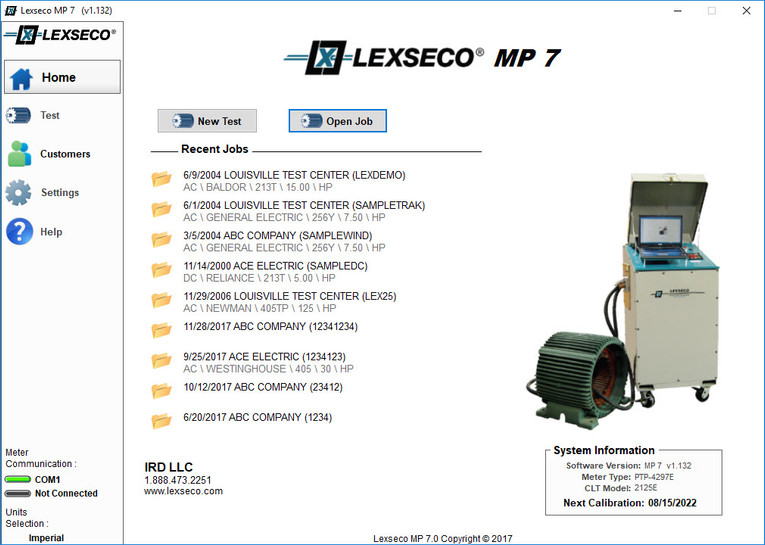
MP7TM is the latest generation of Windows based software used to perform, store, and document the calculations of multiple stator and armature/rotor tests. The software utilizes modern metering technology that provides the user hands-free, automated testing and a newly designed user-interface that allows the software to be more intuitive than ever before. Once installed, previous data from earlier software versions import with the click of a button, providing a seamless transition.
MP7 utilizes a unique multi-parameter data field which permits the software to discriminate between NEMA frames, U frames, T Frames, High Efficiency, and IEC frames, which continues the precision in core loss testing that Lexseco provides. It streamlines the testing and calculation procedures and allows for the documentation of all testing.This in turn allows for the history of a particular piece of equipment to be tracked throughout its life, and with its robust storage database, it offers the ease of looking up specific data in case of customer inquiries.
The Multi-parameter Approach
- A Simple Process
The four-step process (entering job information, equipment information, component information, and testing) is intuitive as a step-by-step process for you to follow. With clear instructions and an easy-to-use, icon-driven interface to ensure proper data entry, reliability and efficiency have never been more attainable.
- Searchable Database
Streamlining repairs has never been easier. Having a searchable database allows the operator to sort previous tests by the variable that is easiest to work with. You can search by whatever information is available at the time, and with a Microsoft Windows operating system, detailed motor repair records are literally at your fingertips.
- Import Thermographic Images
Importing thermal images takes the guess work out of identifying hot spots. This also helps to show you how deep the hot spot actually is, which is helpful when performing the repair. *Does not include thermographic camera
- Printable Reports
Having a savable and printable report means the paper trail can follow each piece of equipment (internally or externally). This also gives you a detailed finished report that you can provide your customer with as proof of the repair and work done.
Perform Multiple Tests
Core Loss Test - A core loss test is a procedure in which a core loss tester subjects a motor component to high current at low voltage to simulate operating conditions in the core. Voltage, amperage,and wattage readings are supplied to the core loss tester’s software. The software uses these values , along with the dimensions of the core, to calculate the watts per pound (or watts per kilogram) core loss. The value of the core loss test is to identify the motors that should be repaired and those that should not.
Hot Spot Test - A hot spot test is a procedure in which the core is subjected to amperage that is two to three times greater than the amperage measured during a core loss test. This high amperage is maintained for several minutes until noticeable hot spots are detected on the core. This test identifies the area of the core that needs to be repaired.
Loop Test - A loop test is a test used to calculate core loss in which the number of loops is varied, rather than the voltage, to achieve the target flux density. The loop test is used for large stators that are beyond the capacity of your core loss tester. During a loop test, the voltage is held constant to the value supplied by the fixed power source. The number of loops, or turns, of wire is calculated to achieve the target flux density. This test can be used if the stator is outside the capacity of the core loss tester that the customer has. It allows for the calculation of the watts per pound/kilogram.
Winding Verification Test – A winding verification test is a procedure in which data of the specific motor that is to be redesigned is entered into MP7. MP7 will calculate the tooth flux density, back iron flux density, and air gap flux density along with the calculations for wire size in circular mils per amp. It ensures the efficiency of the winding design for the specific motor.
Integrity Test – An integrity test uses the core loss tester as an AC power source to magnetize the rotor core. The operator identifies failed cage windings by using magnetic paper or iron fillings to check for broken bars and end ring blow holes (air voids). This test shows the operator which bars are broken and need to be replaced.
Temperature Differential Test – A temperature differential test applies an increased voltage to the rotor for a short period of time. If there is cage damage, this will demonstrate uneven heating in the bars, especially at the connection of the bar and the end ring. Depending on the specific nature of the problem, the fault area may spark as the voltage attempts to cross the air gap. This can check for areas that may be faulty that may not show with other tests on the rotor.
General Test – A general test can be performed without the use of a core loss tester. The user can enter the nameplate information, as well as generate test data, vibration data, and conditions of the motor component. A report can then be generated, listing all the general test information about the component. This allows the operator to put information from tests performed on other test equipment into one comprehensive report.
Interested in upgrading? Want to learn more about MP7’s software? Contact sales@irdproducts.com or call us at +1 502 366 0916.